2025 National Academic Annual Meeting on the Theory and Applications of Partial Differential Equations and Forum on Operations Research and Artificial Intelligence Successfully Held
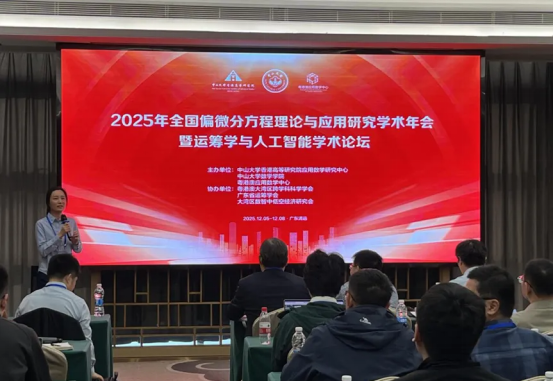
From December 6 to 7, the two-day “2025 National Academic Annual Meeting on the Theory and Applications of Partial Differential Equations and Forum on Operations Research and Artificial Intelligence” was held in Qingyuan, Guangdong.
The event was jointly organized by the Applied Mathematics Research Center of Sun Yat-sen University Institute of Advanced Studies Hong Kong (SYSUIASHK), the School of Mathematics of Sun Yat-sen University (SYSU), and the Guangdong-Hong Kong-Macao National Center for Applied Mathematics, and co-organized by the Interdisciplinary Science Society of the Guangdong–Hong Kong–Macao Greater Bay Area, the Guangdong Operations Research Society, and the Greater Bay Area Digital Intelligence Mid-Low AltitudeEconomy Research Association. Experts and scholars from dozens of universities and research institutions nationwide delivered 24 invited talks, engaging in in-depth exchanges on the latest research outcomes through thematic presentations and frontier discussions.
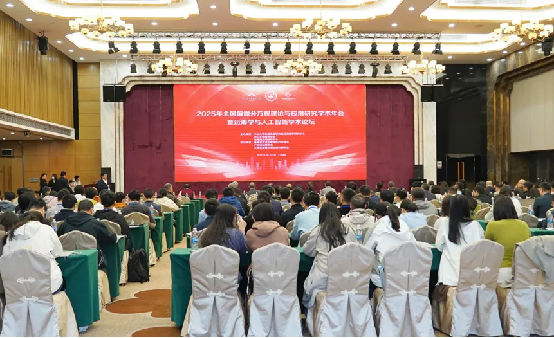
At the opening ceremony, Professor Yao Zheng’an, Director of the Applied Mathematics Research Center of SYSUIASHK,noted that partial differential equations are entering a new era full of opportunities. He emphasized that in the age of artificial intelligence, solutions generated by AI ultimately require rigorous PDE theory for verification and interpretation. Meanwhile, profound results in PDE theory concerning stability and convergence will provide a more solid mathematical foundation for AI model construction. “This is a profound, two-way convergence”, he stated. He added that this academic annual meeting aims to foster theoretical breakthroughs through high-level exchanges, cultivate young talent, and provide mathematical support for major national scientific and technological needs.
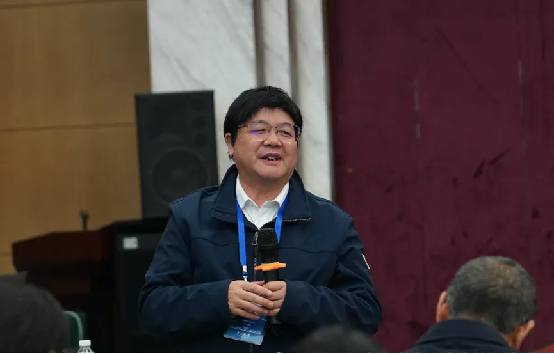
Professor Xin Zhouping from The Chinese University of Hong Kong stated in his remarks that holding this academic annual meeting in Qingyuan, Guangdong, reminded him of the phrase “fragrance spreads far” (similar words in Chinese). He noted that this resonates with the experience of doing mathematics, especially partial differential equations. Good mathematics, he said, should possess two qualities: depth, reaching the essence and revealing long-term value; and communicability, inspiring resonance. He further observed that partial differential equations serve as a bridge, connecting information with content, investigation with concepts, and integrating mathematics with work in other fields.
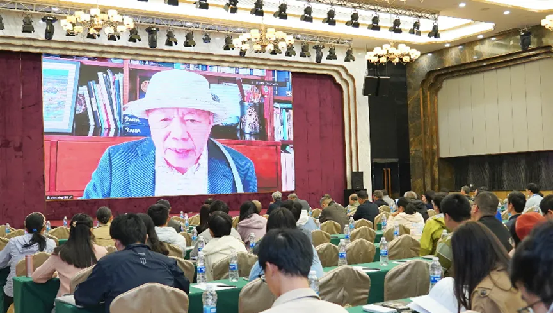
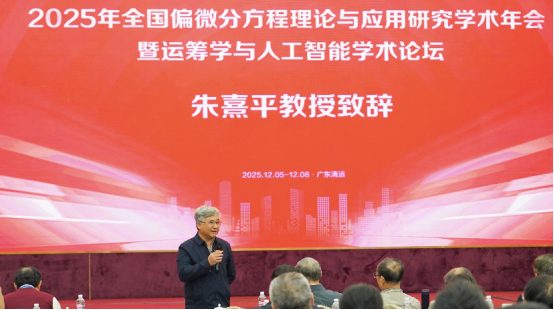
Zhu Xiping from Sun Yat-sen University expressed agreement with Professor Xin Zhouping’s view on the bridging role of partial differential equations. He remarked that PDEs lead both to the deep theoretical core of pure mathematics and are firmly rooted in the vast domain of applied mathematics, with particularly significant implications on the applied side.
“Those engaged in PDE research who achieve insight and advancement in this field, leaving their mark in history, will have accomplished something worthy of lifelong pride”, he said, encouraging participating scholars to further advance the field through conference exchanges.
During the plenary session, scholars from different universities shared their latest research achievements.
Professor Wang Weike from Shanghai Jiao Tong University delivered a report entitled Global solution of 3-D Keller-Segel model with Couette flow in whole space, exploring the interaction between the Keller–Segel model and Couette flow.
Professor Yin Jingxue from South China Normal University presented Recent Progress on Semilinear Pseudo-Parabolic Equations, studying a class of semilinear pseudo-parabolic equations with nonlinear source terms, which can be viewed as pseudo-parabolic regularizations of the heat equation.
Professor Chen Hua from Wuhan University reported on Fine Embeddings and Geometric Inequalities for General Hörmander Vector Fields, investigating function embeddings and geometric inequalities in generalized Sobolev spaces defined by Hörmander vector field systems.
Professor Jin Shi from Shanghai Jiao Tong University shared the academic report Quantum Computing for Hamilton–Jacobi Equations: Multivalued Solutions and Viscosity Solutions, and the Quantum Scientific Computing Platform ‘UnitaryLab’. He introduced the quantum scientific computing platform “UnitaryLab”, which aims to provide quantum algorithm solutions for scientific computing problems, with version 1.0 designed to solve ordinary and partial differential equations using quantum algorithms.
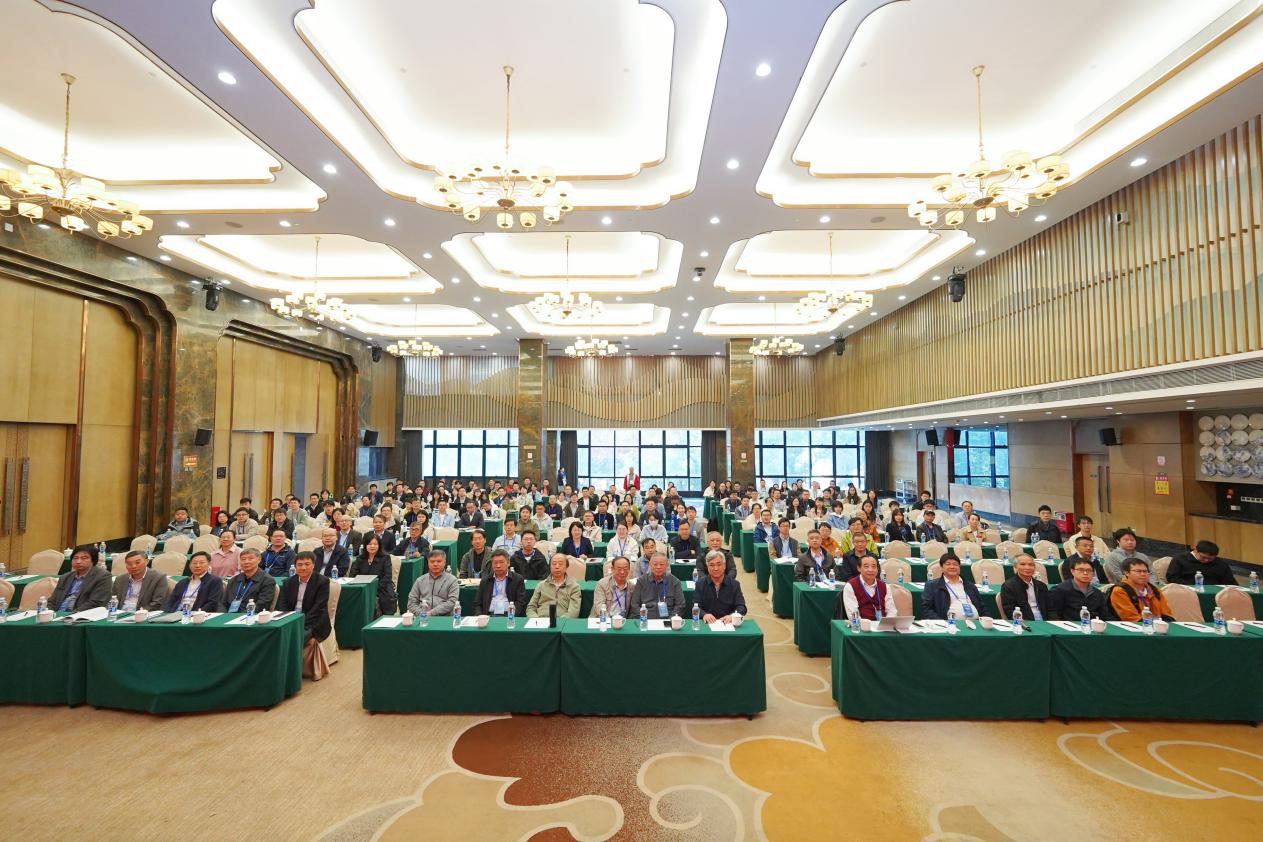
The event featured multiple high-quality presentations and sub-parallel sessions, focusing on core topics including PDE theory and applications, as well as the interdisciplinary integration of operations research and artificial intelligence. Discussions covered fluid mechanics, plasma physics, mathematical biology, geometric analysis, nonlinear analysis, and related areas.
Among them, Professpr Li Fucai from Nanjing University delivered a talk titled Recent Advances in Kinetic-MHD Models, reporting his latest research results on well-posedness and long-time behavior of kinetic magnetohydrodynamic models widely applied in plasma physics.
Professor Zhang Ting from Zhejiang University presented Global Existence of Strong Solutions to Stochastic Three-Dimensional Incompressible Anisotropic Navier–Stokes Equations, proving the probabilistic global existence of strong solutions when the initial horizontal forcing is sufficiently small or the horizontal viscosity coefficient is sufficiently large.
Professor Ren Xiao, Research Fellow from Fudan University, approached the topic from a geometric perspective in Geometric Characterization of Potential Singularities in the Navier–Stokes Equations, extending the renowned Constantin–Fefferman theorem to more general scale-invariant settings.
In addition, multiple scholars reported breakthrough progress in scientific computing, chemotaxis systems, free boundary problems, thermoelastic systems, and stability thresholds of equations.
The “Forum on Operations Research and Artificial Intelligence” held on December 7 was jointly organized by Professor Wang Xiao and Professor Zhang Zaikun from Sun Yat-sen University. The forum focused on innovations in optimization theory, breakthroughs in algorithm design, and their wide applications in machine learning, engineering optimization, and data science, highlighting the critical role of fundamental mathematical research in supporting AI development. Invited speakers including Professor Lü Zhaosong from the University of Minnesota, Professor Han Deren from Beihang University, and Chair Professor Chen Xiaojun from The Hong Kong Polytechnic University delivered invited talks introducing the latest advances in optimization theory and algorithms, as well as their powerful applications in solving practical problems and even pure mathematics questions.
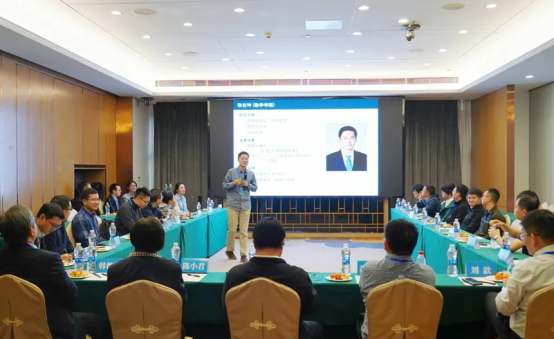
The forum also featured a dedicated roundtable session on the development of optimization disciplines at Sun Yat-sen University. The session was chaired by Professor Zhang Zaikun from Sun Yat-sen University, who systematically introduced the optimization team’s profile, research layout, scientific achievements, and future plans. Professor Yao Zheng’an from SYSU, Chair Professor Chen Xiaojun from The Hong Kong Polytechnic University, Professor Lü Zhaosong from the University of Minnesota, Professor Han Deren from Beihang University, Professor Liu Xin from the Chinese Academy of Sciences, and Professor Du Lili from Shenzhen University contributed perspectives on discipline planning, inter-institutional collaboration, industry–academia integration, and young talent cultivation, jointly outlining future development pathways for Sun Yat-sen University in the intersection of optimization and artificial intelligence.
This conference was not only an academic gathering in the fields of partial differential equations, operations research, and artificial intelligence, but also an important platform for interdisciplinary scientific collaboration and industry–research alignment in the Guangdong–Hong Kong–Macao Greater Bay Area. Participating experts unanimously agreed that PDE theory and operations optimization methods will continue to provide essential theoretical support for frontier fields such as artificial intelligence, intelligent manufacturing, and biomedicine, contributing to the Greater Bay Area’s development into an internationally influential center of scientific and technological innovation.